
 Հայերեն
 English
 Русский
 Français
 Español
 Deutsch
 Italiano
 العربية
 中文
中文
 हिन्दी
 Polski

Sights of Armenia Syunik
Khndzoresk Cave Village
- RegionSyunik
- Distance from Yerevan250.3 km
- TypeCave
Syunik
About this place
About 13 kilometers southeast of Goris, on the mountainous slopes at the northeastern edge of the village of Khndzoresk, lies the historic settlement known as Old Khndzoresk.
In its early stages, the homes in Khndzoresk were mainly cave dwellings, sometimes located 20–30 meters above the ground. These cave-houses were used not only for living but also for defensive purposes. Over time, stone houses were built in front of the caves, arranged in a terraced fashion—so that the courtyard of the upper house served as the roof of the lower one.
One of the most notable monuments of Khndzoresk is the fortress, which served as the military base of Mkhitar Sparapet between 1728 and 1730. Over different periods, four churches were built in the village, of which St. Thaddeus (17th–18th centuries) and St. Hripsime (1666) remain standing. The latter is a three-nave basilica. Though now ruined, the Anapat Church once served as a center for manuscript copying and preservation. Mkhitar Sparapet is buried in the courtyard of this church.
Numerous springs have been preserved in the area, many of which are named after their builders—for example, Ghandunts nov, Telunts, and others. Khndzoresk is also home to the palace of Melik Khaso (built in 1836), and near the Church of St. Thaddeus, a rock-carved reservoir has been preserved.
During the Soviet era, when the need arose to build new housing, residents began dismantling the old structures, using the stones to construct the new village. This caused significant damage to the historical and cultural landscape that had been preserved until then.
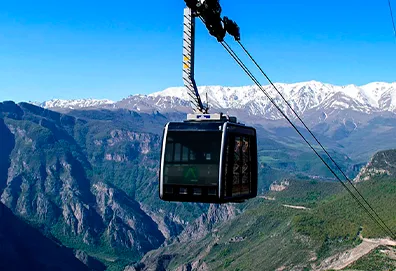
In 2012, a 160-meter-long and 63-meter-high suspension bridge was opened in Khndzoresk. It connects the two sides of Old Khndzoresk’s gorge—Ghandunts nov and the Nerkin tagh (Lower District).
Valuable information about Khndzoresk is provided by Stepanos Orbelian in his historical work “History of the Province of Syunik.
Interesting
facts about Khndzoresk Cave Village
-
Khndzoresk was the largest village in Eastern Armenia in the early 20th century, with a population of about 8,300 people and numerous educational and economic institutions.
-
According to local tradition, the village’s original name was Khor Dzor or Khor Dzoresk, referring to the depth of its gorges and its natural defensibility. Over time, the name evolved into Khndzoresk. The village once consisted of 11 historic districts, including Prrtosi, Tsti, Telunts, Chayluki, and others.
Weather in Syunik
The high season in Armenia lasts for a long time due to the pleasant climate conditions. Warm days in Armenia start in March and last until late autumn; winter is usually snowless and not long. The high precipitation season is variable. The tourist season for Khndzoresk cave village depends on the weather conditions.
Khndzoresk Cave Village
FAQ
Where is Old Khndzoresk?
Old Khndzoresk lies about 13 km southeast of Goris, on the mountain slopes at the northeastern edge of the village of Khndzoresk.
How did people live in the Khndzoresk cave village?
At first the homes were mainly cave dwellings, sometimes 20–30 metres above the ground, used both for living and for defence. Over time stone houses were built in front of the caves in terraces, so that the courtyard of the upper house served as the roof of the lower one.
What is there to see in Khndzoresk?
Highlights include the fortress that served as Mkhitar Sparapet's military base in 1728–1730, the churches of St. Thaddeus (17th–18th centuries) and St. Hripsime (1666), and the ruined Anapat Church, once a centre for copying manuscripts, where Mkhitar Sparapet is buried. There are also the palace of Melik Khaso (1836), a rock-carved reservoir and the suspension bridge opened in 2012, 160 metres long and 63 metres high.
Where does the name Khndzoresk come from?
According to local tradition, the village was originally called Khor Dzor or Khor Dzoresk, referring to its deep gorges and natural defensibility, and over time the name became Khndzoresk. In the early 20th century it was the largest village in Eastern Armenia, with about 8,300 inhabitants and many educational and economic institutions.
Can I visit Khndzoresk on a tour from Yerevan?
Yes — ONE WAY Tour's tours from Yerevan stop here; they are listed on this page.
Syunik
Plan your visit
Address
Khndzoresk Swinging Bridge, Khndzoresk, Syunik Province, Armenia
Tours
Tours visiting Khndzoresk Cave Village
Tours to Khndzoresk → Tours to Syunik →
Syunik
Sights near Khndzoresk Cave Village
ONE WAY TOUR
Book a private tour
Daily group tours, private journeys and transfers across Armenia and Georgia.