
 Հայերեն
 English
 Русский
 Français
 Español
 Deutsch
 Italiano
 العربية
 中文
中文
 हिन्दी
 Polski

Sights of Armenia Aragatsotn
The Church of St. John of Mastara
- RegionAragatsotn
- Distance from Yerevan41.2 km
- TypeMonastery/Church
Aragatsotn
About this place
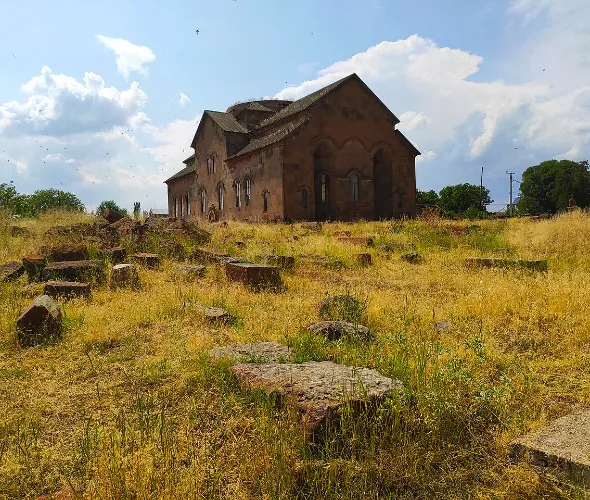
The Church of St. John of Mastara is one of the unique examples of Armenia’s early medieval architecture, located in the center of the village. There are three preserved inscriptions on the church, one of which states that the church was built by the monk Grigoras in the 7th century. However, some experts believe that the inscription refers to the church’s renovation in the 7th century, since, based on its architectural and constructional features, the church is attributed to an earlier period — the 5th century.
St. John’s Church is a centrally domed, four-apse structure. The prayer hall is square-shaped. The church was originally built using large blocks of reddish-purple stone, and in the 7th century was renovated using orange-yellow stones. It was also renovated during the 10th–13th centuries.
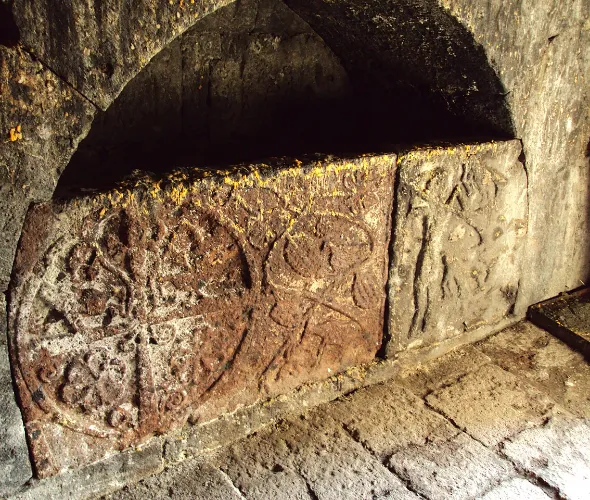
The church’s decoration — the equal-armed crosses on the lintels, the line carvings of cherubs, the cross relief with a pair of birds, and the high-reliefs of doves on the arched crown — is characteristic of 5th-century early medieval Armenian architecture.
The floor plan of Mastara Church served as a model for several other churches, including the Great Church of Artik, St. Astvatsatsin of Voskepar, St. Grigor of Harichavank, and St. Arakelots of Kars.
Interesting
facts about The Church of St. John of Mastara
-
The monastery got its name ""Mastara"" from the village. According to tradition, the right hand relic of St. John the Baptist was brought here and buried, and later a church was built over it and named ""Mastara,"" meaning ""I brought the part"" (mas – part, tara – I brought).
-
St. John’s Church is especially valuable for the perfect composition of its interior space. The harmony of its volumes, the wide-spanning dome, and the strong pendentives that support it give the interior a majestic appearance.
Weather in Aragatsotn
The high season in Armenia lasts for a long time due to the pleasant climate conditions. Warm days in Armenia start in March and last until late autumn; winter is usually snowless and not long. The high precipitation season is variable. The tourist season for Church of St. Hovhannes depends on the weather conditions.
The Church of St. John of Mastara
FAQ
When was the Church of St. John of Mastara built?
One of its three preserved inscriptions says the monk Grigoras built it in the 7th century. Some experts believe this refers to a 7th-century renovation and, judging by its architecture, date the church to the 5th century.
What does the church look like?
It is a centrally domed, four-apse building with a square prayer hall. It was first built of large reddish-purple stone blocks, renovated with orange-yellow stones in the 7th century and renovated again in the 10th–13th centuries.
What decoration can you see on the church?
Look for the equal-armed crosses on the lintels, line carvings of cherubs, a cross relief with a pair of birds and high reliefs of doves on the arched crown, all typical of 5th-century Armenian architecture. Inside, the wide dome on strong pendentives gives the space a majestic look.
Where does the name Mastara come from?
The church takes its name from the village. According to tradition, the right-hand relic of St. John the Baptist was brought and buried here, and the church later built over it was named Mastara, meaning “I brought the part” (mas – part, tara – I brought).
Which churches were modeled on Mastara?
Its floor plan served as a model for several churches, including the Great Church of Artik, St. Astvatsatsin of Voskepar, St. Grigor of Harichavank and St. Arakelots of Kars.
Aragatsotn
Plan your visit
Address
Aragatsotn, Арагацотн, Армения
Aragatsotn
Sights near The Church of St. John of Mastara

ONE WAY TOUR
Book a private tour
Daily group tours, private journeys and transfers across Armenia and Georgia.